| Karplus Lecture - Text Alternative |
 Go Back to the Previous Page Go Back to the Previous Page
Don Cook:
Next, I'd like to introduce to you, Fernand Brunschwig, who came to Berkeley in 1968 as one of the first graduate students in the Science and Mathematics program that Karplus was founding at that time. Fernand had completed his undergraduate degree in Physics at Harvard, and followed by three years of teaching in various schools in North America and Europe. He had heard about Karplus from a history teacher, who was on sabbatical from California. She related to Fernand Karplus's exploits in her school. Brunschwig worked closely with Karplus, teaching several undergraduate courses. His reminiscing on those courses led him to bring out the textbook again. So, it gives me great pleasure to introduce my friend, Fernand Brunschwig.
Fernand Brunschwig:
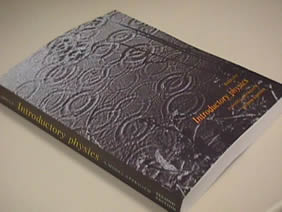
I am thrilled to present you with the new edition of Bob Karplus' wonderful textbook, Introductory Physics: A Model Approach. I would like to begin by describing what I like to call Bob Karplus' science education "toolkit." This will give you some insight into his thinking about teaching and curriculum development, which form the framework for the book. Then, I'll tell you about the book, and particularly why I think it is still innovative. Finally, I'll speculate a bit about what I think the message of Bob's work might be to us here today.
I was lucky enough to have Bob as a mentor during my four years of graduate work at Berkeley. He was a truly outstanding teacher, mentor and role model, and in the process of organizing this event I was amazed at the variety of people around the world who had been Bob's students and colleagues. Bob was outstanding in many ways, with an extraordinarily fertile mind, a legendary grasp of physics, and a warm, engaging, generous personality.
 Bob had an amazing gift for being able to invent a simple, memorable concept that organized and integrated a complexity of detail. He could also explain his thinking in such clear, direct, down-to-earth language that he made it seem easy. As I came to understand it, Bob's approach to teaching was composed of just four, easy-to-describe items: Bob had an amazing gift for being able to invent a simple, memorable concept that organized and integrated a complexity of detail. He could also explain his thinking in such clear, direct, down-to-earth language that he made it seem easy. As I came to understand it, Bob's approach to teaching was composed of just four, easy-to-describe items:
- The Learning Cycle (consisting of 3 parts: exploration, invention and discovery).
- The critical interplay between autonomy and input.
- The plastic nature of the conceptual structure of science, especially physics.
- The application of scientific method to the teaching/learning process itself.
These four ideas are simple to list, but a mass of complexity lies within them. Let's look at each of them in turn.
Go Back to the Previous Page
|



